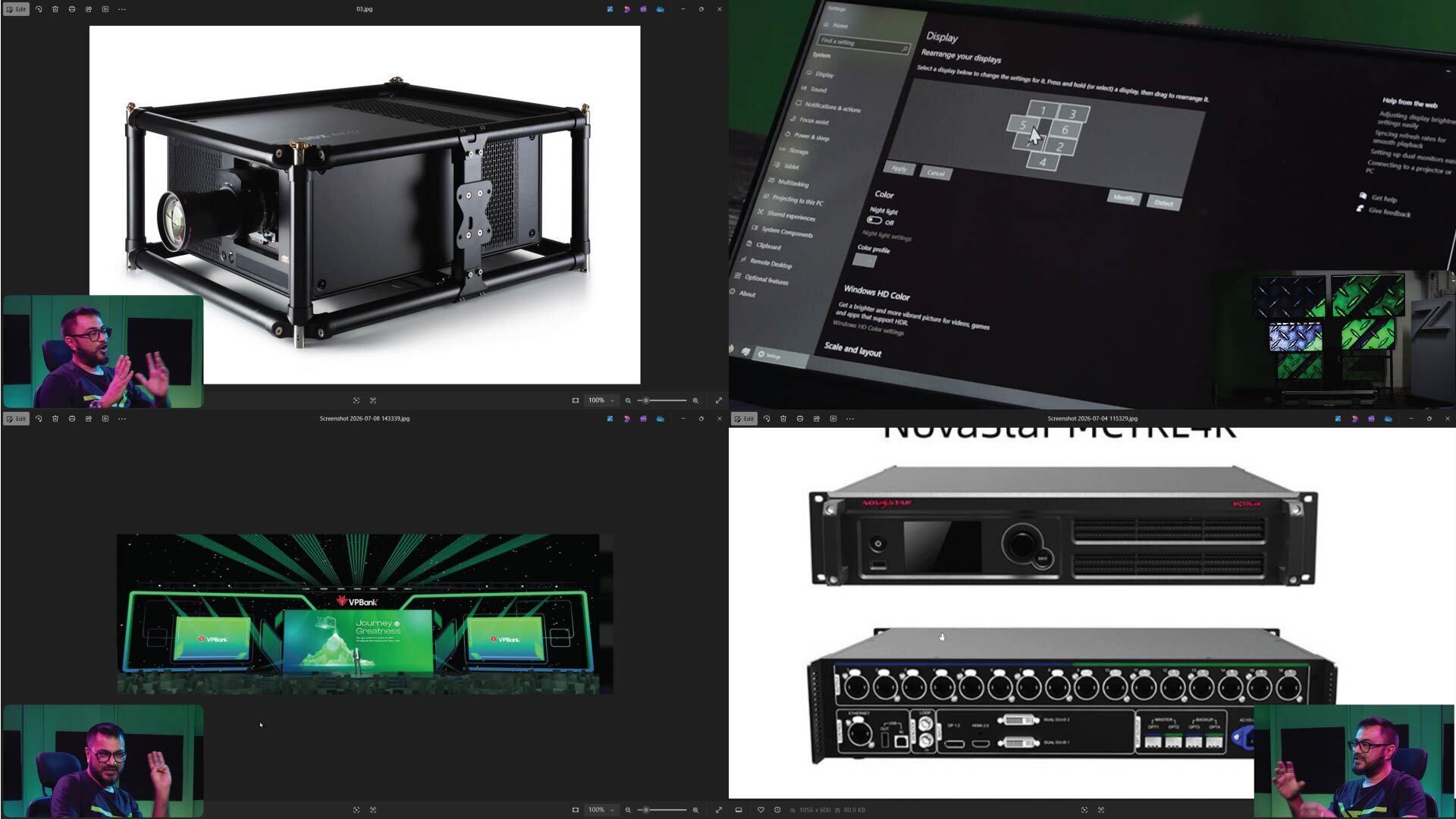

Why these three terms get confused
Projection mapping, stacking, and stitching all involve more than one projector or a non-standard surface, so they blur together for people new to the field. They solve different problems, though, and knowing which one you actually need changes your entire setup.
Projection mapping — fitting visuals to a surface's shape
Projection mapping means adjusting your visual content to precisely fit an irregular or non-flat surface — a building facade, a sculpture, a set piece — rather than a flat rectangular screen. It's about geometry: slicing, masking, and warping content so it lines up exactly with the physical shape it's being projected onto.
Stacking — combining projectors for brightness
Stacking means pointing two or more projectors at the exact same surface, aligned on top of each other, to combine their output. The goal isn't more coverage — it's more brightness and richer color, useful when ambient light or a large surface would wash out a single projector's output.
Stitching — combining projectors for coverage
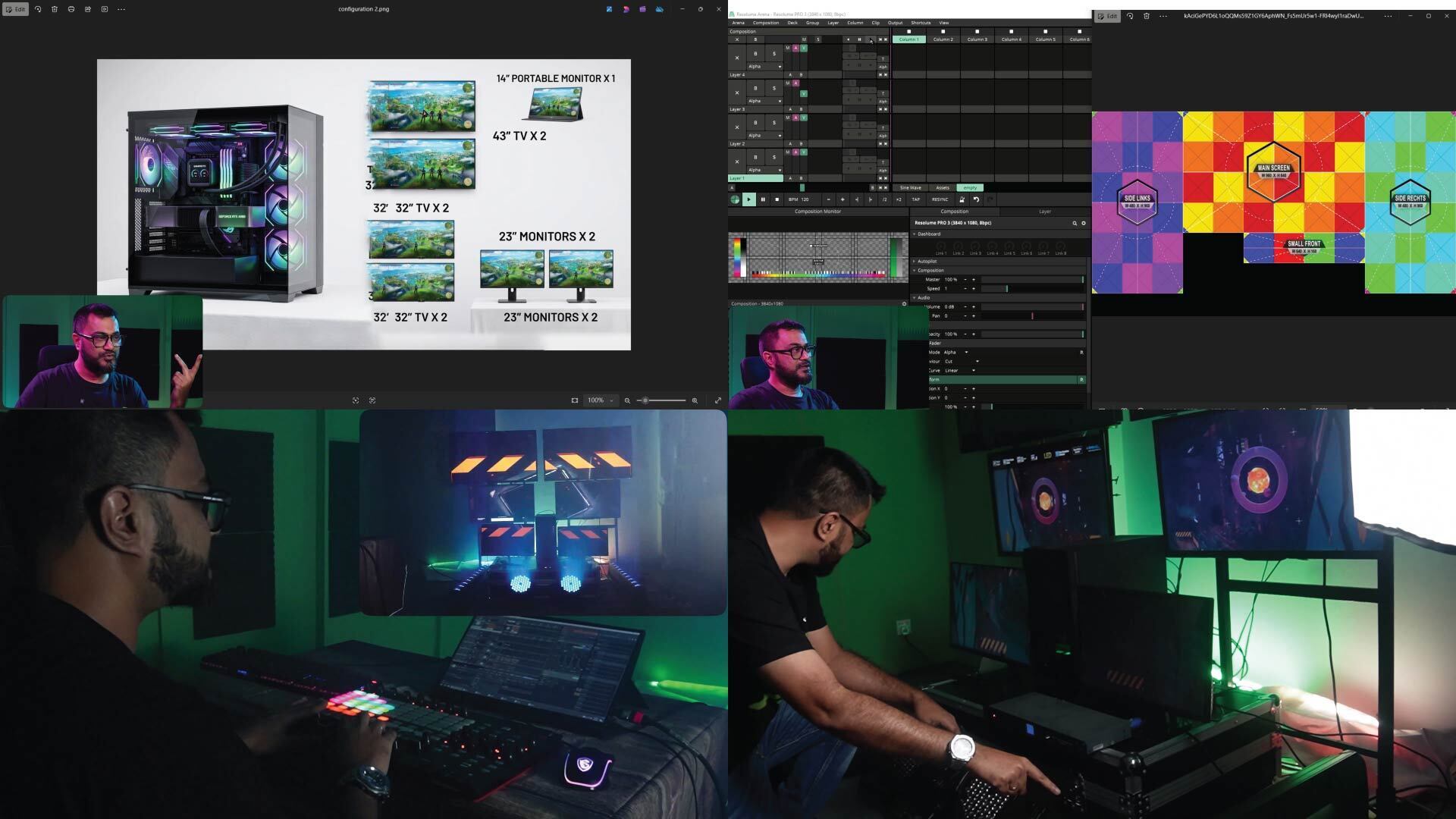
Stitching means placing two or more projectors side by side, each covering a different section of a larger surface, blended together at the seams so the result looks like one continuous image. The goal here is coverage — a surface too wide or too large for any single projector to cover on its own.
How they combine in real shows
These techniques aren't mutually exclusive. A single show might stitch three projectors across a wide stage backdrop, while also stacking two of them on the center section for extra brightness where the audience focus is strongest — all while the content itself is mapped to fit non-flat set pieces within that backdrop.
Quick reference
- Projection mapping solves matching content to surface shape — any number of projectors, any position
- Stacking solves brightness and color richness — same position, same surface
- Stitching solves coverage across a large surface — side by side, blended seams
Learn all three together
These three techniques are taught as one connected skill set — not separately — inside Advanced Outputs & Mapping — Resolume Arena, alongside real multi-display and venue-rider scenarios.
Enroll: Advanced Outputs & Mapping — Resolume Arena — https://studio-z.ca/all-courses/resolume-arena-advanced-outputs-mapping/ (short: tinyurl.com/resolumeMapping)



Top comments (0)